‘Viewpoint’
Project 2 – Improbable Images
Exercise 5.3 – Looking at Photography
Brief
If photography is an event then looking at photography should also be an event.
Look again at Henri Cartier-Bresson’s photograph Behind the Gare Saint-Lazare in Part Three. (If you can get to the Victoria & Albert Museum in London you can see an original print
on permanent display in the Photography Gallery.) Is there a single element in the image that you could say is the pivotal ‘point’ to which the eye returns again and again? What information does this ‘point’ contain? Remember that a point is not a shape. It may be a place, or even a ‘discontinuity’ – a gap. The most important thing though is not to try to guess the ‘right answer’ but to make a creative response, to articulate your ‘personal voice’.
Include a short response to Behind the Gare Saint-Lazare in your learning log. You can be as imaginative as you like. In order to contextualise your discussion, you might want to include one or two of your own shots, and you may wish to refer to Rinko Kawauchi’s photograph mentioned above or the Theatres series by Hiroshi Sugimoto discussed in Part Three. Write about 300 words.
(Bloomfield, 2018)
Henri Cartier-Bresson
https://www.artsy.net/artwork/henri-cartier-bresson-behind-the-gare-saint-lazare
If you click on the link above it will take you to the famous image. I must say before this, when I first used HCB in my work, in the image, my eye kept leading to the same position time and time again, and no matter how hard I would try to look around the image, the silhouette was really intriguing and I was so interested in the figure. Asking myself questions like ‘I wonder who that is’ and ‘ I wonder why he is there’ and so on. That is the part in which my eye returns to time and time again, sometimes I look at the reflection one as well because it is symmetrical. There is no information as such it contains, but a sense of wonder, an emptiness because at the end of it all, it is just a silhouette. You cannot see who it is, just an outline of the figure.
(Cartier-Bresson, 1932)
Hiroshi Sugimoto
For Sugimoto’s work, it is the opposite. I cannot look at the blank cinema screen for too long as it hurts my eyes as there is nothing but white. Nothing to focus on and it feels strain and it makes me look away from the screen. But because there is not much else to look at surrounding the screen you go back, instantly forgetting your past experience, then repeating it all over again. The point contains no information.
.
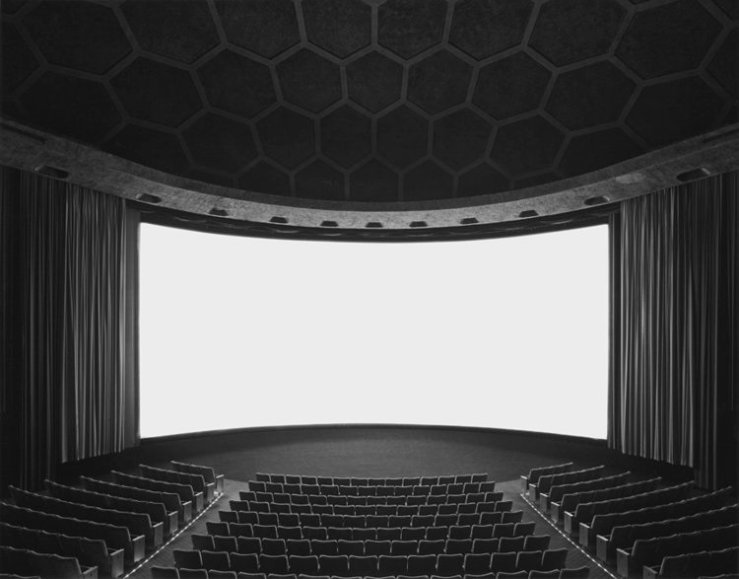
Fig.39. Cinerama Dome (1993)
My Own
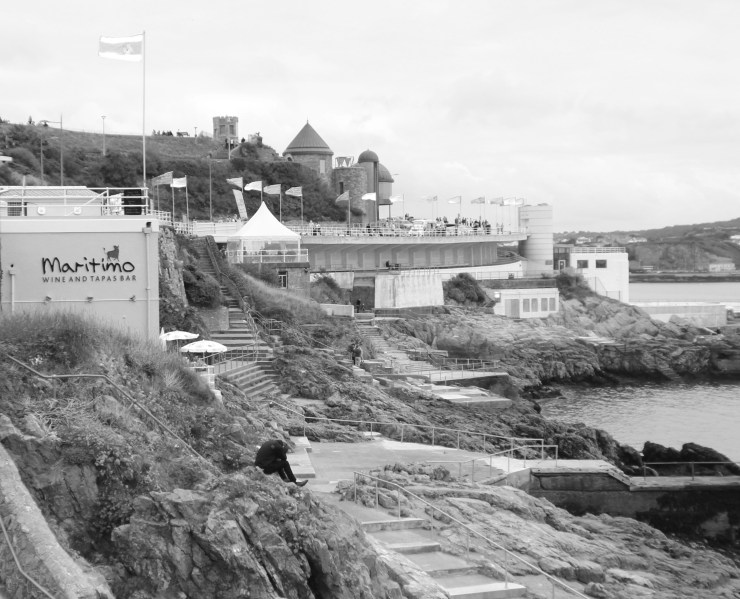
Fig.40. (s.n.) (s.d.)
The image you see above was used in my GCSE/A Levels. I still have my work from them. I was looking for this image because I remember that when I took this, I didn’t even realise the person on the rock had his head down like he was disappointed or upset, and he is not the main reason for the image, and he is not a massive factor in the image, but as soon as a saw him, like the HCB image, I was just kept wondering what was up with him. How he is framed in the image is really great as well because he is just there on his own and away from all the other people in the distance. I feel this image is very powerful and once you see him you keep going back. The point shows he is emotional, and he is alone, it is really interesting how he has been captured.
Aperture, ISO, Shutter Speed
Image 1 –
Aperture: 7.1
ISO: 100
Shutter Speed: 1/125
The Ideal Mode
Further down in EYV it talks about shooting modes and what would be an ideal one. It also asks what you used last in exercise 5.2. In 5.2 I used Manuel mode, like I do on most of my shoots as it has that extra creative flair to it which means you can be more experimental. Also, it doesn’t feel like cheating, like using some of the other modes. I think since starting this course, my creativity has really been starting to show, and coming through and hopefully I can progress this to something even better. My ideal mode would be, creativity.
© Lewis.Gibson.Photography.2019
 Gibsonphotography